Street-Legal (LSV) vs. Standard Golf Cart: Which Do You Need in Sarasota?
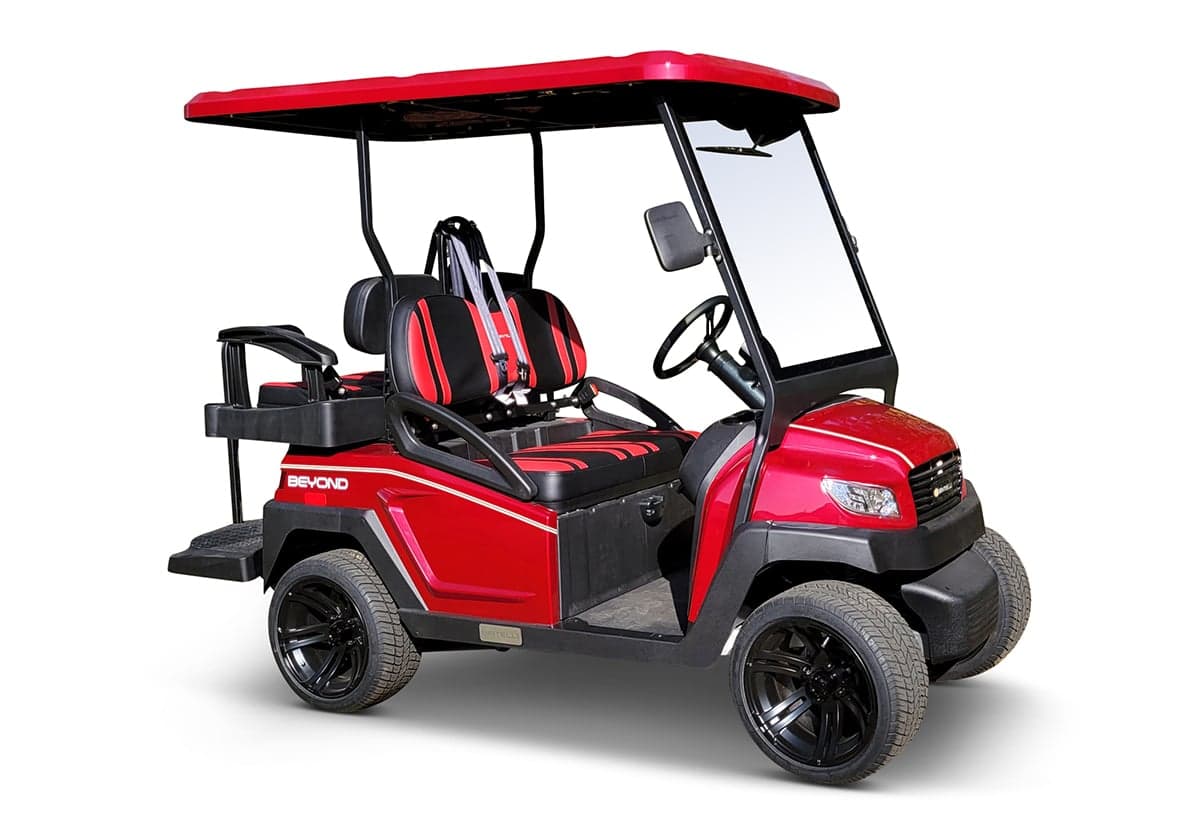
The 30-second answer
Staying inside one island neighborhood and never leaving it? A standard golf cart is cheaper and gets the job done. Want to drive real roads, run between beaches, or leave the sand for lunch? You need a street-legal LSV. That's the whole lsv vs golf cart decision in one line.
The rest of this is about which one fits where you're actually staying, because every barrier island around here has its own quirks.
What a street legal golf cart in Sarasota really means
Florida treats these as two different vehicles, and the labels matter.
A standard golf cart is defined by state law as a cart that can't go faster than 20 mph. No license plate, no insurance, no registration. The trade-off is where you can drive it: only on roads a local government has specifically designated for golf carts, which in practice are low-speed residential streets. It's daytime-only too, between sunrise and sunset, unless the cart has headlights, brake lights, turn signals, and a windshield and the local government has approved night use. Any operator 18 or older needs a valid government-issued photo ID; under-18 drivers need a learner's permit or driver license.
A low-speed vehicle (LSV) tops out between 20 and 25 mph and is a titled, plated, insured vehicle in the state's eyes. Florida requires PIP and property-damage liability coverage on it, and the driver has to hold a valid driver license. An LSV is legal on any public road posted 35 mph or less, and it can cross a faster road at an intersection. It also comes equipped like a scaled-down car: headlights, turn signals, brake and tail lamps, mirrors, seat belts, a windshield, a parking brake, and a VIN.
So the real question isn't which is "better." It's this: do I need a street legal golf cart for where I'm going?
Standard cart vs. LSV, side by side
| Standard golf cart | Street-legal LSV | |
|---|---|---|
| Top speed | Up to 20 mph | 20–25 mph |
| License plate | No | Yes |
| Insurance | Not required | Required (PIP + PDL) |
| Driver license | Photo ID at 18+; learner's/license under 18 | Valid driver license, all drivers |
| Where it's legal | Only roads designated for golf carts (low-speed streets) | Any public road posted 35 mph or less |
| Cross a bridge or faster road | No | Only where posted 35 or less, or across at an approved intersection |
| Rental cost | Lower | Higher |
| Best for | One low-speed neighborhood | Getting around the island grid |
Where you're staying decides it
Siesta Key
Most rental carts on Siesta are LSVs, which is what you want. A plated LSV lets you run Midnight Pass Road legally between Siesta Key Village, Crescent Beach, and Turtle Beach on the 35-and-under stretches.
Here's the catch every visitor asks about: you can't drive any cart off the island. To leave Siesta Key you cross either the north bridge at Siesta Drive or the Stickney Point Bridge to the south, and both connect to roads posted well above 35 mph. Plated or not, no cart legally crosses them. Rent to explore the Key, not to commute off it.
Anna Maria Island
AMI is the most cart-friendly island in the county. Carts and LSVs are fine on any road posted 35 or less, which covers nearly everything: Pine Avenue in Anna Maria, Bridge Street in Bradenton Beach, Gulf Drive down to Coquina Beach, and the run north toward Bean Point.
But the bridges to the mainland are the same story. LSVs aren't permitted across the Manatee Avenue bridge, which is posted above 35. The Cortez Bridge (SR 684) is posted 35 mph per FDOT — technically inside the LSV limit — but verify signage during construction, and every rental operator prohibits leaving the island anyway. Practically: you've got the whole island, not the mainland.
Longboat Key
Longboat is the one island where the standard-vs-LSV line barely matters, because the main road is off-limits to both. Gulf of Mexico Drive runs 40 to 45 mph the length of the island, and no golf cart and no LSV may legally drive on it. You're limited to the village and side streets posted 35 or less, and a plain golf cart is boxed in even tighter. If you're staying on Longboat, an LSV gives you the neighborhood streets and that's about it.
Sarasota mainland, St. Armands, Lido, and Venice
On the Sarasota mainland and city streets, a standard cart has almost nowhere legal to go. You need a plated LSV, and even then you stick to streets posted 35 or less. Around St. Armands Circle and Lido Key an LSV works on the slower village streets, but the John Ringling Causeway over to downtown is posted higher, so don't plan on driving it. In Venice, the calm grid near Caspersen Beach and the fishing pier is comfortable LSV territory on the low-speed roads.
So, which do you need?
If your whole trip lives inside one low-speed neighborhood, book the standard cart and save money. If you want the freedom to drive the island's main roads, hit more than one beach, or grab dinner without moving the car, get the street-legal LSV. On Longboat and the mainland, an LSV isn't a luxury, it's the only cart that's legal at all.
CartBooker.com compares every local operator in one place, so you can match the cart to your street before you book. Browse golf cart rentals in Sarasota, or jump straight to Siesta Key rentals and Anna Maria Island rentals.
Frequently asked questions
Do I need a street-legal golf cart in Sarasota?
It depends on where you're staying. Inside a single low-speed neighborhood, a standard golf cart is legal and cheaper. To drive the main island roads, the Sarasota mainland, or anywhere city streets are involved, you need a street-legal LSV, which is titled, plated, insured, and registered.
Can I drive a golf cart off Siesta Key across the bridge?
No. Both routes off Siesta Key, the north bridge at Siesta Drive and the Stickney Point Bridge, connect to roads posted above 35 mph. Neither a standard golf cart nor a street-legal LSV may legally cross them, so any cart you rent stays on the island.
What's the difference between an LSV and a golf cart in Florida?
A golf cart can't exceed 20 mph and needs no plate, insurance, or registration, but it's limited to roads a local government has specifically designated for golf carts. An LSV goes 20 to 25 mph and is a titled, plated, insured vehicle that's legal on any public road posted 35 mph or less.
Do you need insurance and a driver license for an LSV?
Yes. Florida requires an LSV to carry personal injury protection and property-damage liability insurance, and the driver must hold a valid driver license. A standard golf cart carries no insurance requirement, and adults only need a valid government-issued photo ID to operate one.
Can I drive a golf cart on Gulf of Mexico Drive on Longboat Key?
No. Gulf of Mexico Drive is posted at 40 to 45 mph, above the legal limit for both golf carts and LSVs. On Longboat Key you're restricted to the village and side streets posted 35 mph or less.
Sources
- Fla. Stat. § 316.212 — golf cart operation on designated roads
- Fla. Stat. § 316.2122 — operation of low-speed vehicles
- Fla. Stat. § 320.01 — definitions: golf cart, low-speed vehicle
- FLHSMV — low-speed vehicle titling, registration and insurance
Road-use rules last reviewed August 23, 2026. Posted limits and signage control on the day you drive; rental operators may impose stricter terms.
Ready to ride?
Compare listed golf cart operators town by town: seat counts, photos, Google ratings and the ones you can book online.
Find a golf cart rentalMore golf cart guides
The Complete Longboat Key Golf Cart Rental Guide
Discover essential information for renting golf carts in Longboat Key, Florida.
The Complete Venice Golf Cart Rental Guide
Explore Venice's top golf cart rental options and tips for an unforgettable experience.
The Complete Scenic Highway 30A / Santa Rosa Beach Golf Cart Rental Guide
Explore the ultimate guide to renting golf carts along Scenic Highway 30A and Santa Rosa Beach.